Showing posts with label slavery. Show all posts

Monday, March 7, 2016

The RETURN of AATOP!

IOFA is excited to announce the re-launch of the Asian American Trafficking Outreach Project (AATOP) with generous support from Help for Children/Hedge Funds Cares.
AATOP will build upon the pilot project’s efforts to raise awareness, engage the Asian American community and build capacity of AA serving providers to identify, refer and respond to the needs of survivors of human trafficking in culturally and linguistically appropriate ways.

AATOP’s Beginnings:
The International Organization for Adolescents (IOFA), created AATOP as a one year pilot project with funding from the Asian Giving Circle in 2012.  Its goals were to build capacity of Asian American service providers to identify, refer, and respond to survivors of human trafficking from Asian American communities.  AATOP also worked to increase Asian American service organizations to participate in anti-trafficking coalitions and task forces.  AATOP reached these goals by partnering with various Asian American service providers to hold trainings and community events.
AATOP’s Pilot Program Key Outcomes and Accomplishments: 
  • reached out to and built relationships with around 25 API-serving social service, legal, research, community, leadership, and educational institutions and organizations
  • hosted a general community forum with a variety of service providers
  • hosted a meet and greet for attorneys with the Asian Pacific Legal Advocacy Network (APLAN)
  • conducted a human trafficking training for attorneys with the Chicago Bar Association (CBA)
  • developed a mental health specific training for clinicians working within these communities
  • hosted a Filipino-specific community forum with Filipino project partner CIRCA Pintig
  • had staff teach as a guest lecturer at University of Illinois Chicago’s Asian American Studies Program.
AATOP’s Relaunch:
With support from Help for Children/Hedge Fund Cares (HFC), AATOP’s 2016 activities will focus on connecting with social service providers serving Asian American children and youth.  AATOP will work in collaboration with these programs to increase their capacity to identify trafficked children and/or youth and refer them to culturally and linguistically appropriate trauma informed services.
AATOP Project Goals:
  • Engage and educate Asian American communities across Chicago to create a coordinated response to human trafficking.
  • Train a cadre of health, mental health and other social services professionals serving Asian American communities across Chicago to identify and assist trafficking survivors.
  • Implement culturally and linguistically appropriate outreach activities and campaigns to to raise awareness of human trafficking in Asian American communities across metropolitan Chicago.
  • AATOP’s outreach and training activities will be guided by a Community Advisory Board whose members will represent the diverse Asian American community.  The community advisory board will assist AATOP connect to resources and give input to ensure activies are as culturally and linguistically appropriate as possible.
The Asian American Trafficking Outreach Project (AATOP) aims to fill a critical gap that currently exists in outreach efforts to potential victims of human trafficking in Asian American communities. Many Asian countries are listed as sources of trafficked labor according to the U.S. Department of State’s Trafficking in Persons Report. Vulnerable Asian immigrants in Chicago are susceptible to human trafficking in massage parlors, restaurants, factories, and other low-wage, unregulated industries that rely heavily on undocumented labor.  Young people within Asian communities are uniquely vulnerable, as they may be dealing with social pressure and stigma related to their adult development, in addition financial hardship.
Although victims of trafficking have the right to services and benefits under the Trafficking Victims Protection Act of 2000, Asian American victims of this crime face significant obstacles in accessing services in the Chicago metropolitan area to which they are entitled. To date, little has been done to adapt training and outreach efforts to the Asian American community. The need for sensitization within the community regarding victim-centered service and treatment has also been noted by community-based researchers. IOFA’s initial survey of agencies serving human trafficking victims found that while agencies received significant numbers of clients of Asian descent, Asian American-focused organizations remain underrepresented in anti-trafficking coalitions and task forces.
This project seeks to address mental health needs within Asian American communities and promote safe environments and improved service delivery to human trafficking victims and those at risk within this population.  The inclusion of Asian American serving organizations in anti-trafficking efforts in Chicago, coupled with training and technical assistance, will provide organizations working in Asian American communities with resources they need to successfully identify and serve human trafficking victims.

Follow us on social media!
Facebook: AATOP CHICAGO
Twitteer: @AATOPCHICAGO
Instagram: @AATOPCHICAGO
Blog: aatopchicago.blogspot.com

For more information, contact Project Coordinator, Jody Haskin at jhaskin@iofa.org 
or Jae Jin Pak, AATOP Community Advisory Board Chair at jpak@iofa.org

Learn more about IOFA and AATOP at http://iofa.org

Wednesday, July 10, 2013

The Worst Form of Child Labor: Child Soldiers

Child Soldier in Burma
The Myanmar Armed Forces discharged 42 children from its ranks on July 7th, due to pressure from the United Nations. The UN hailed this action as a positive step for the country towards its integration into the International Community and compliance with human rights standards. However, this is a small step compared to Myanmar's history of use of child soldiers. Myanmar is the only country in the region in which the government run armed forces forcibly recruit child soldiers into the army; children between the ages of 12-16 year old. Johnny and Luther Htoo, twin brother who jointly led the God's Army Guerrilla group, were estimated to have been ten years old when they began leading the group in 1997. According to Human Right's Watch,  as many as 70,000 boys serve in the national military, the Tatmandaw, which children as young as 11. Further, there are 5,000-7,000 children serving in ethnic opposition militias.


Girl Soldier in Burma

What is Child Soldering?

Child Soldiering is a manifestation of human trafficking when it involves the unlawful recruitment or use of children through force, fraud or coercion, as combatants or for labor or sexual exploitation by armed forces. The perpetrators of human trafficking are government forces, paramilitary organizations, and rebel groups. 
Children are abducted from their homes and villages to be used as combatants, porters, cooks, guards, servants, messengers, and spies. Girls are often forced to marry or have sex with male combatants. Orphans, refugees, and other displaced children are particularly at risk. They are brutally indoctrinated in order to ensure complete loyalty, threatened with death or dismemberment if they do't fight, and forced to kill friends who try to escape.
Over 300,000 children are serving as a child soldiers. According to the Asian Wall Street Journal, a third of those children are in Asia. The reason that children are used as soldiers is because their age lends them to be 
Child Soldiers in Filipino Rebel Force
extremely obedient. They can be forced to become dependent on the military, they are young enough to be brainwashed, they are cheaper to feed than regular soldiers, and are often more fearless than their older 
counterparts, and therefore willing to risk more in battle. Further, opposing armies are less likely to harm children.

In the Philippines, children are recruited by rebel forces for service in the army, most notably for the new People's Army, the Abu Sayyaf Group, and the Moro National Liberation Front. An estimated 13% of the 10,000 soldiers in the Moro National Liberation Front are children.

In Sri Lanka, thousands of children are thought to be  in the ranks of the Liberation Tigers of Tamil Elem 
(LTTE), a rebel group categorized as a terrorist organization by most of the world's government. Sri Lankan 
soldiers nicknamed one of LTTE's units the Baby Battalion, due to the amount of child soldiers serving in its 
ranks. Thanks to international pressure, however, the LTTE promised to discharge all soldiers under 18 by 2007. However, Karuka Group, a splinter group, now has begun recruiting child soldiers. 
Children in the LTTE in Sri Lanka

Ramifications


There are significant ramifications for child soldiers. Often, when arrested, children are charged as adults and treated as war criminals, despite the age that they had been when they committed many of the war atrocities. Beyond legal ramifications, there are significant emotional and physical consequences of child soldiering. Child soldiers are often wounded, disfigured, or killed. They suffer significant emotional trauma, and are often unable to adapt to the ordinary world. Further, many times they had missed out on education and opportunities to develop social and communication skills. They have often been exposed to HIV/AIDS, and in the case of the girls, pregnancy, and early motherhood.

Legal Instruments in Place


The International community has passed a significant amount of legislation to combat child soldiering. Some legislation are:
Optional Protocol to the Covenant on the Rights of the Child on the Involvement of Children in Armed Conflict: Prohibits the forced recruitment of children under the age of 18 into governmental armed forces. Also requires Parties to criminalize the recruitment of children by non-state armed groups, such as rebel or separatist militias
ILO Convention 182: Defines he forced recruitment of children for use in armed conflict as 'one of the worst forms of child labor'
Kimberly Process: An international effort to prevent conflict diamonds from entering the market; children are often used to protect and mine these diamonds.
Paris Commitment and Prevention on Children Associated with Armed Forces or Armed Groups: A pledge from the international community to stop the forced recruitment of children into armed forces and to support their rehabilitation and reintegration into society.


Jasmine
Intern

Monday, July 8, 2013

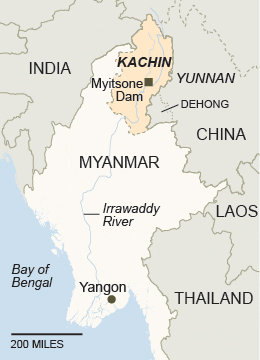
The Economics of Trafficking: The Kachin and Burma

Human Trafficking is a lucrative business. The United States estimates that per year, 600,000-800,000 persons are trafficked across international borders. It is though that 2.5 million people are being trafficked around the world at any given time. This generates an estimated annual global profit of $32 billion dollars. It is the third largest illegal industry in the world after drugs and armed sales. In this post, we examine the economic and social factors motivating the human trafficking of one particular population: the Kachin.

The Kachin

Kachin women in traditional garb

The Kachin is a population that has been a target of human trafficking, due to the nature of their situation. The Kachin people are a group of ethnic peoples who inhabit the Kachin Hills, from which the population derives its name, in northern Burma and neighboring areas of China and India. This population has been greatly effected by the conflict between the Burmese government and the Kachin Independence Army. The Burmese government has attempted to expel this population group, therefore rendering them extremely vulnerable. actors that have proved dangerous to the Kachin. Since June 2011, when the Burmese military ended a 17 year ceasefire and launched an offensive against the Kachin Independence Army, there have been 24 documented instances of trafficked individuals; however, those are only the documented cases. The Kachin Women's Association-Thailand (KWAT) published a report stating that Kachin women and children are particularly vulnerable to trafficking, and it is an extremely lucrative business for the traffickers.

Fast Facts

  • Between 2004-2007, there were 133 verified trafficking cases, involving 163 women and girls
  • A quarter of those trafficked were under 18, with girls as young as 14 forced to be brides
  • The continuing high incidence of trafficking indicates that the regime's new anti-trafficking legislation is failing to have any impact
  • The Kachin population are vulnerable due to
    • forced migration
    • lack of recognition from government
    • lack of governmental power

Why Are the Kachin So Vulnerable?

Part of the problem is the way they are treated in Burma. As the government has attempted to expel them from the country, they have no official governmental recognition, therefore rendering them extremely vulnerable as there are no programs in place to protect them, nor records of individuals when they go missing. Further, due to the conflict, approximately 100,000 people have been uprooted in the last two years and are now living in displacement camps. The Burmese government has also barred international aid organizations from accessing refugee camps housing the Kachin, and China has refused to provide assistance to Kachins who are seeking refuge across the border. In August 2012, the Chinese government even forced thousands of Kachins who were seeking shelter in the country back into Burma. "Push tens of thousands of people to China's doorstep, deprive them of food and status, and you've created a perfect storm for human trafficking," said KWAT spokesperson Julia Marip.
Kachin Women's Association-Thailand

Who is Trafficked?

Women and children are profitable income sources for traffickers. Women are either sold as brides or into brothels or massage parlors. China's one-child policy has created a particular market for trafficked Kachin women. Currently in China there are 117 men for every 100 women, and by 2020 there will be 30 million men looking for brides among 24 million women. Kachin women are considered favorable brides due to the lightness of their skin and proximity to the border. Kachin women are also thought of as fertile and excellent child bearers. They are sold for around $6,5000. Traffickers either kidnap women who are either migrating to the city from their villages, or will go into villages and refugee camps and offer families a dowry, playing on traditional customs. Chinese businessmen form a significant portion of the clientele. Lower income Chinese men pay brokers to fetch women from Myanmar families. Other women are trafficked into Thailand's sex industry; trafficked sex workers are often raped, and are sold from $300 upwards to the prostitution industry

Kachin Refugee Camp in Burma
Children are also viewed as highly sought after commodities by traffickers as well. Children trafficked to Thailand are occasionally rented out from parents. Brokers offer around $100-224 a month for children; children can earn from $15-100 a day working as beggars or shop assistants. Owners often beat children who are working as beggars so they appeal more to alms givers. Children also make excellent assistants as they can be paid less, are less likely to attempt to escape, and are more subservient in general; the favored age by traffickers are 3 month old toddlers to children under ten years of age. Young children are also sold to fuel Thailand's growing adoption rackets; others are sold into the child prostitution industry. Traffickers use the Internet to dodge international forces against child proposition. Recently, NGOs' efforts and stricter Thai laws have created a crack down on child trafficking, therefore increasing the demand for child trafficking as the supply dwindles.


Jasmine Prokscha
Intern

Tuesday, June 25, 2013

Official Complicity with Human Trafficking

Although actions must be taken at all levels, it is crucial to any anti-human trafficking movement to have strong governmental support and action. However, according to the U.S. State Department's report on trafficking around the world, there are many governments whose officials who comply with, or even aid, traffickers. For example, NGOs in Malaysia have reported that the police often will not investigate complaints that employers are confiscating passports, travel documents, or withholding wages as possible trafficking offenses. Furthermore, in 2010 the government did not report any prosecutions of employers who subjected workers to conditions of forced labor, nor were any government officials convicted of trafficking related complicity, despite numerous reports of collusion between police and trafficking offenders. Police collaboration is a common thread throughout many countries; local law enforcement officials are willing to take bribes to look the other way when presented with cases of human trafficking, or, at the most extreme, are the ones perpetrating human trafficking themselves.


India
One such example is India. The report stated "Official complicity in trafficking was a serious problem that remained largely addressed by the government. Corrupt politicians, police, and border security forces on both sides of the India-Bangladesh border reportedly recognized a token used by human traffickers to evade arrest if caught at the border." Some corrupt law enforcement officers facilitated the movement of sex trafficking victims, protected suspected traffickers and brothel keepers from enforcement of the law, took bribes from sex trafficking establishments and sexual services from victims, and tipped off sex and labor traffickers to impede rescue efforts. Many owners of brothels, rice mills, brick kilns, and stone quarries who engaged in human trafficking were politically connected and therefore immune from prosecution.Further, of the Anti-Human Trafficking Units established by the government, many were criticized as being ineffective or only existing on paper and not in practice. Furthermore, there was significant complicity of some governmental officials in human trafficking. Many sources noted that the Indian central government approached anti-trafficking measures in an uncoordinated and piecemeal manner, therefore allowing for greater instances of corruption.
One highly publicized case of sexual and physical abuse, including both sex and labor trafficking, of women and children in Apna Ghar shelter for mistreated victims in the state of Haryana, demonstrates the pervasiveness of official compliance with human trafficking. Not only was the shelter run by the state, but police officers reportedly raped some of the inhabitants and destroyed evidence once an investigation into the home commenced.


Burma
Burma is one of the highest offenders in regards to official complicity in human trafficking. The Military is the main perpetrators. Internally, there are several different ways in which the military implements human trafficking. The military engages in the unlawful conscription of child soldiers. Boys as young as 10 years are forcibly recruited to serve in the Burmese army and ethnic armed groups through intimidation, coercion, threats, and violence. Children of the urban poor are at particular risk of involuntary conscription; UN reports indicates that the army has targeted orphans and children on the streets and in railway stations, as well as young novice monks from monasteries for recruitment. It also continues to be the main perpetrator of forced or compulsory labor inside Burma. Military and civilian officials target minors of ethnic minority groups, and use men, women, and children for forced labor for the development of infrastructure and state-run agricultural and commercial ventures, as well as forced portering for the military. 
An NGO study published in 2010 found an acute problem in Chin State, where a survey of over 600 households indicated that over 600 households indicated that over 92% experienced at least one instance of a household member subject to forced labor; the Burmese military reportedly imposed two-thirds of these forced labor demands. Children are often subjected to forced labor in tea shops, home industries, and agricultural plantations. Exploiters traffic girls for the purpose of prostitution, particularly in urban areas. There are also reports that Burmese officials kidnapped Rohingya women from Sittwe and subjected them to sexual slavery on military installations. There were also reports that victims deported from Thailand into Democratic Karen Buddhist Army controlled areas of Burma continue to be extorted and retrafficked by DKBA elements, in collusion with Thai officials.
How can the military do this? There are many causes of human trafficking in Burma. The military regime's climate of impunity, gross economic mismanagement, and the acceptance of child soldiers as a method of recruitment remain top causal factors. Further, the authorities refuse to recognize members of certain ethnic minority groups, such as the Rohingyas, as citizens and provide them with identification documentation, which make them a prime target.


Vietnam
The Vietnamese government is complicit in human trafficking as it has certain programs in place that human traffickers can easily utilize to gain access to their victims. For example, Vietnam is a source country for men and women who migrate abroad for work opportunities. Many of the migrants are process through state-affiliated export companies which coerce migrants to sign contracts in languages they cannot read, and charged exorbitant fees, sometimes as much as $10,000. This has forced Vietnamese migrants to incur some of the highest debts among Asian expatriate workers, making them highly vulnerable to debt bondage and forced labor. Also, there has been a significant lack of prosecution of perpetrators of human trafficking; many NGOs claim that government officials are often willing to turn a blind eye towards trafficking in return for bribes.


Thailand
Thailand's greatest issue is corrupt law enforcement. The majorities of networks that traffic foreigners into Thailand tend to be small and not high organized, those who traffic Thai victims abroad tend to be more organized and work in more formal networks and will collaborate with law enforcement officials. Also, as the Thai government has no official laws that address sex tourism, there remains greater leeway for sex trafficking. Broader issues in regards to the Thai government and trafficking are local police corruption, including direct involvement in and facilitation of human trafficking, biases against migrant laborers, lack of understanding among local officials and courts in regards to human trafficking, particularly labor abuse cases, and finally systematic disincentives for trafficking victims to be identified. Corruption is one of the largest issues as it is widespread among Thai law enforcement personnel, creating an enabling environment for human trafficking to prosper. There are reports that officials protect brothels, other commercial sex venues, and seafood and sweatshop facilities form raids and inspections. Furthermore, there are also reports that Thai police and immigration officials extort money or sex from Burmese citizens detained in Thailand for immigration violations, and sell Burmese people who are unable to pay labor brokers and sex traffickers.
Further, due to the refusal of the Thai government to grant legal status to Ethnic minorities from the northern Hill Tribes, these populations are at an extremely high risk for trafficking.


Cambodia
Cambodia has a significant history of human trafficking, due to the longtime civil unrest that created an unstable environment rendering many homeless; refugees are particular targets for human traffickers. Furthermore, there are reports that some law enforcement and government officials are believed to have accepted bribes to facilitate the trafficking and sex trade. There are other reports of government officials who are complicit in the trafficking by accepting bribes. Corrupt officials facilitate the transportation of victims across the border, or route migrants deported from Thailand to human traffickers. However, there have been several large-scale prosecutions of police officials for trafficking corruption charges. The former Deputy Director of the Police Anti-Human Trafficking and Juvenile Protection Department was convicted for complicity in trafficking and sentenced to five years' imprisonment; two officials under his supervision were also convicted and sentenced to seven years' imprisonment. Another example was when police arrested two military officers and one member of the military police for running brothels and trafficking.


Jasmine Prokscha
Intern

Tuesday, June 18, 2013

7-11 Franchise Owners Arrested in Labor Trafficking Scheme


On Monday, eight men and one woman from Long Island were arrested with conspiring to commit wire fraud, with stealing identities of U.S. citizens, and with concealing and harboring illegal aliens employed at 7-Eleven Inc. franchise stores in Long Island and Virginia. The identities stolen included three deceased persons and one eight year old child. The arrests were made by U.S. Immigration and Customs Enforcement's (ICE) Homeland Security Investigations (HSI), the Social Security Administration's Office of the Inspector General, the New York State Police, and the Suffolk County Police.

The defendants, who owned the 7- Eleven franchises, created a scheme in which they allegedly hired over 50 illegal aliens and gave them identities stolen from U.S. citizens. U.S. Attorney for the District of New York Loretta Lynch stated that the defendants allegedly forced the immigrants to work 100 hours a week and stole the majority of their pay by taking substantial portions of the paychecks that they received from corporate headquarters.

The defendants also forced their employees to live in and pay cash rent in unregulated and overcrowded boarding houses they owned. Lynch referred to this system as a "plantation system", which has allegedly been going on for more than 13 years. The defendants trafficked the workers from Pakistan or the Philippines, where they had roots, thereby enabling them to recruit from within their own ethnic communities.


Most surprising: there were no safeguards in place at the national 7-Eleven Inc. payroll office. Despite the fact that the defendants had put the same social security numbers for victims working in both Virginia and New York, checks were still sent to both of them. The case began two years ago when a 7-Eleven employee approached the new York State Police about not being paid for his work; later another worker contacted the Suffolk County Police.


This operation highlights several issues often seen in cases of labor trafficking. One, the ease in which people are able to perpetrate these crimes. There was no apparent connection between the two families, yet they both committed similar types of fraud. Second, the victims were classified by the state as "illegal immigrants". Although agents from ICE are currently treating the workers as potential witnesses and are not seeking to move to deport them, Ms. Lynch stated that she felt that the employees "were not innocent victims in this scheme" although "they had been abused". Further investigation is necessary, but in the meantime, these workers should be viewed as potential victims of labor trafficking, brought to the U.S. and exploited.

 ICE, however, did put this note on the bottom of their on-line report:

HSI encourages the public to report suspected labor trafficking, forced labor or the exploitation of undocumented workers through its toll-free hotline at 1-866-347-2423 (from the U.S. and Canada), or from anywhere in the world at 1-802-872-6199, or online at www.ice.gov/tips.

Monday, January 21, 2013

Join IOFA's "Human Trafficking is OUR Problem" campaign to fight modern day slavery

Many people here in the U.S. still think that human trafficking is a problem that happens far away, to non-U.S. citizens, to the "other." Few realize how human trafficking directly affects us as individuals and how it is an issue the we all need to solve in our immediate communities. IOFA's "Human Trafficking is OUR Problem" campaign will aim to bring awareness about the most surprising details about the crime of human trafficking and engage people directly in getting this message out there. 

Would you like to be directly involved in building awareness of human trafficking? We need your help! Here are 3 easy steps:

1. Download and print out of of the "Human Trafficking is OUR Problem" signs. Click the "download" button below the signs and hit print.
Human Trafficking is OUR Problem signs 

     
2. Use your IPhone, camera, or computer camera to take a picture of you and anyone else you can fit in holding the HTIOP sign. Make sure that text on the sign is clear and visible.
 
3. Upload your photo(s) and send as an attachment via email to eliew@iofa.org

Here are some examples:


Your image will be included with hundreds of others in a new IOFA video to be distributed to the public and our anti-trafficking networks. Recruit your friends, family members, pets, and everyone who wants to end modern day slavery. Post the sign and these instructions to your Facebook and Twitter pages.

Let us all be part of this new generation that is fighting against modern day slavery. Human trafficking happens in OUR neighborhoods - the city, the suburbs, and the farmlands.

We look forward to your photos! Please let us know if you have technical difficulties or need assistance. Thanks for your support!