We invite you to join us on January 24 at our winter fundraiser at Farmhouse for an evening of food and drinks! Your contributions will go toward IOFA's projects to remove youth from vulnerable situations and transition them into care.
Click here to purchase your ticket. Help us to spread the word and we look forward to meeting you all soon!
Brothels that front as massage parlors are closer to you
than you think – they are located down from your streets and in your
neighborhoods. The following news story from the Center Square Journal attests to the prevalence of coerced commercial sexual
services, both adults and minors, in the massage parlor businesses in Chicago:
Report: Human Trafficking Pervasive in Massage Parlors
By Sam Charles | Friday, December 7, 2012
According to a report published by the Chicago Alliance Against Sexual Exploitation and Not In Our Name!, a group made up of massage therapists against sex trafficking, the culture of massage parlors is conducive to sex trafficking in the United States. A recent report by Center Square Journal identified several area massage parlors where sexual favors are allegedly offered by mainly East Asian immigrants. Check a map of the reviewed massage parlors here.
“Human traffickers are using the massage industry as a cover and a way for sex trade customers to identify and connect with paid sex opportunities, often times with women who have no other choices,” the report stated.
The study, released earlier this year, concludes that one of the driving factors behind sex trafficking is the constant demand for it. “Johns,” those who pay for sexual favors, are driving the industry, the report said.
“This group constitutes the demand for sexual acts from women, men, transgendered individuals and children,” the report stated. “Purchasing sex is often an act of asserting power and control. Buying sex from another person dehumanizes the victim because it puts a price on a person’s self-worth.”
According to the report, In 2008, nearly 67 percent of prostitution-related arrests in Chicago were of prostituted people, 34 percent were of customers, and only 1 percent were of pimps.
“This approach fails to address the root cause of prostitution: the demand,” the report said.
Most of the massage parlors in Brown Line Media‘s coverage area operate out of smaller spaces, typically below residential spaces along busy streets.
According to the report, commercial front brothels that claim to specialize in Asian techniques operate by pretending to offer legitimate services (i.e. massages, acupuncture, etc.), but actually primarily provide commercial sex. The victims are most often Asian women, both documented and undocumented.
None of the six massage parlors in Brown Line Media‘s coverage area that allegedly offer sexual favors commented on the sites’ reviews.
All of the establishments in Roscoe View Journal and Center Square Journal‘s coverage area that allegedly offer clients sexual gratification also currently hold a Chicago Massage Establishment License, according to city records.
Chicago’s Department of Business Affairs is responsible for granting licenses and inspecting businesses that seek and are granted Massage Establishment Licenses. To acquire a license, massage parlor proprietors must be fingerprinted, pass a background check, employ only those with personal massage licenses and provide copies of all massage therapist licenses issued by the Illinois Department of Financial and Professional Regulation for every employee or prospective employee. These inspections, according to the department website, are administered before the license is initially granted and every two years when the license is renewed, in addition to periodic random inspections.
According the department’s website, “Message establishment operators should not allow its employees, agents or independent contractors to touch, or offer or agree to touch the sexual or genital area of any person. Engaging in any of these acts makes the Massage Establishment licensee strictly liable for revocation or suspension of the license.”
The report acknowledged that trafficking may be difficult to see in the open, but there are several tell-tale signs of massage establishments that engage in human trafficking, such as:
Suggestive or blatantly sexual advertising.
An expired or nonexistent license.
Darkened, obstructed, or covered windows.
People coming and going at odd times.
Mostly male clientele utilizing the establishment.
Predominantly Asian women, of diverse ethnicities and nationalities, including Korean, Thai, Chinese, and ethnically Korean-Chinese citizens performing the services.
President Obama made his first post-election visit abroad two
weeks ago to three countries in Southeast Asia. He spent November 18th
in Thailand and held a joint press conference with Thai Prime Minister,
Yingluck Shinawatra. On November 19th, he journeyed to Burma and met
with Burmese President Thein Sein and Member of Parliament who was formerly
under political house arrest, Aung San Suu Kyi. He then attended the East Asia
summit in Cambodia on November 20th and met with leaders of the
Association of Southeast Asian Nations (ASEAN). This trip was significant not
only because President Obama was the first U.S. president to visit Burma and
Cambodia, but also because he raised the priority human rights issue of human
trafficking in his conversations with leaders in each of the three countries.
This visit echoes in action the address that President Obama
gave at the Clinton Global Initiative in September, which he focused entirely
on human trafficking in the form labor and sex services, both in the United
States and globally. He began describing human trafficking as such:
“It ought to concern every person, because
it is a debasement of our common humanity. It ought to concern every
community, because it tears at our social fabric. It ought to concern
every business, because it distorts markets. It ought to concern every
nation, because it endangers public health and fuels violence and organized
crime. I’m talking about the
injustice, the outrage, of human trafficking, which must be called by its true
name -- modern slavery. “
Recognizing that it
is a tragedy that “modern slavery” should exist in the U.S. but acknowledging
that the U.S. has resources and technical knowledge to be a leader in the
anti-trafficking movement, the president called to attention these
anti-trafficking initiatives that his Administration has designed:
·Executive
order strengthening protections in federal contracts: The U.S. is
strengthening adherence to its zero-tolerance policy on human trafficking
within government contracts in the U.S. and overseas.
·Tools and
training to identify and assist trafficking victims: Government employed
professionals from the local to federal levels who are most likely to cross
paths with trafficking victims will be provided human trafficking training.
·Increased
resources for victims of human trafficking: Social services and legal
assistance for trafficking victims will be expanded so they will have increased
access to help. The T-visa application and prosecution of the victims’
traffickers are being streamlined to expedite processing times.
·Comprehensive
plan for future action: The first strategic action plan to strengthen
services for victims of trafficking and the first domestic human trafficking
assessment tool to track trafficking trends in the U.S. is being developed by
federal intelligence agencies.
President Obama's speech at the CGI
The President calls upon members of every community to be educated on
human trafficking and join in on the existing efforts to combat this worldwide
epidemic. In the same address, he urges Congress to renew the Trafficking
Victims Protection Act, which he says, is “something
we should all agree on”, whether Democrat or Republican.
On his visit, President Obama commended Burma on the extensive progress
made toward its transition to democracy and addressing sex and labor
trafficking in the last two years. Burma has repealed the 1907 Towns and
Villages Act, which condoned government use of forced labor and has enacted the
2012 Wards and Village Tracts Administration Act, which criminalizes all forms
of forced labor. It has also signed a child soldiers action plan with the UN to
release child soldiers from the Burmese military. These are just a few signs of
evidence for Burma’s advance in human rights.
President Obama meets Aung San Suu Kyi (Official White House photo)
In his subsequent conversations
with the Thai and Cambodian leaders, President Obama affirms that the technical
knowledge and practices developed by the U.S. and its partners in
anti-trafficking efforts will be shared with all three countries. The bilateral
partnerships between the U.S. and these countries signify cooperative efforts
to share ideas and learn from each other how to tackle this issue. However,
human trafficking is not a standalone issue; therefore, the U.S. will work with
the Thai, Burmese, and Cambodian leaders to improve education, revamp public
health systems, and focus on human development from childhood.
This visit seems to have provided added momentum for the
anti-trafficking movement in Asia. With such a huge focus on trafficking as
President Obama begins his second term, those already engaged in
anti-trafficking work are looking forward to greater development in advocacy
and services for victims as well as abusers being held accountable to their
crimes. It is a tremendous sign of progress as the covert operations of human
trafficking are being exposed and awareness of the issue has gained prominence
in the last decade.
In 2003, a New York Times identified Chicago as a national
hub for human trafficking. Chicago’s airports, including one of the world’s
largest airports, the O’Hare International Airport, and the major crossings of
large interstates make entry for traffickers and victims much more accessible.
These victims are then dispersed from this major Midwest location to
neighboring states, cities, and towns. Not to mention that with the percentage
of foreign-born individuals at 21.1%, trafficking victims could look like any
number of immigrants in the city. However, it’s important to note that trafficking
victims can be both non-U.S. citizens and U.S. citizens. In addition, Chicago
as a vibrant tourist attraction keeps demand high as people travel in and out
of the city.
Here are some more facts and statistics that call for the
urgent need to address human trafficking in Chicago:
In the state of Illinois,
most of the Latin American and Asian trafficked victims are found in the
Chicagoland area.
Chicago hosts an abundance
of large scale events that attract traffickers to bring victims to cater
to event attendees.
16,000 to 25,000 women and
girls are trafficked each year in Chicago. One third of them get involved
in trafficking by the age of 15 and 62% by the age of 18.
In Cook County (in which
Chicago belongs), massage parlors and strip clubs front sex trafficking
businesses.
The labor trafficking
takes advantage of the large immigrant population in Chicago. This
includes forced begging and soliciting, domestic servitude, and forced
labor in restaurants.
Between December 2007 and
June 2009, the National Human Trafficking Resource Center received 257
calls from Illinois, which ranks fifth on highest number of calls after
Texas, California, New York, and Florida.
Illinois currently has legislation in place that that aims
to protect and not criminalize human trafficking victims. The Trafficking of Persons and Involuntary
Servitude Act of Illinois went into effect in 2006, proclaiming it an
offense for trafficking persons for forced servitude including minors,
increasing access to health and social services for victims, and imposing
severe penalties for traffickers. During the same year, the Illinois Predator Accountability Act was
enacted to allow sex trafficked victims to sue their abusers and anyone who
profited from their activities. Furthermore In 2010, the Illinois Safe Children Act was signed into law, thus being one of
the first states to implement comprehensive legislation that trafficked
children under 18 will be protected from criminal prosecution.
This article
describes the criminalization of prostitution in Chicago that relegates sex
workers to felony status. Even when they want to exit the sex industry, they
are hard pressed to find legitimate employers who will hire ex-felons. If they
are denied a self-supporting job and public services, they often return to sex
work as their only immediate source of income and survival. While I interned as
a case worker last year for a social service agency, I saw numerous ex-felons
come through our job readiness training program. Although we could refer them
to several appropriate employers, the job options were extremely limited. Sex
workers should be given more opportunities for self-advancement, including
education, supportive services, social services, and broader job options. There
is no use in labeling an individual as a felon and then expect them to
contribute to the job economy if they cannot access formal employment opportunities.
In 2011, the Justice
for Victims of Sex Trafficking Crimes Act was signed into law, enabling sex
trafficking victims who were convicted as prostitutes to clear their criminal
records of forced commercial sex acts. Children and many non-consenting adults
who are forced to perform commercial sex acts are not actually engaging in
prostitution; instead, they are falling victim to abusive individuals who
exploit their age, lack of options, and social isolation for profit. They need protection
and the right to resources and provision of necessities like clothing, food,
transportation, and counseling that will help them to rebuild their lives. Despite
these legislative victories, victims still need specialized services to help
them get back on their feet. Trafficked victims did not choose to be slaves.
Often those in the sex industry have been coerced into the life and do not need
their dignity stripped further by being labeled as criminals.
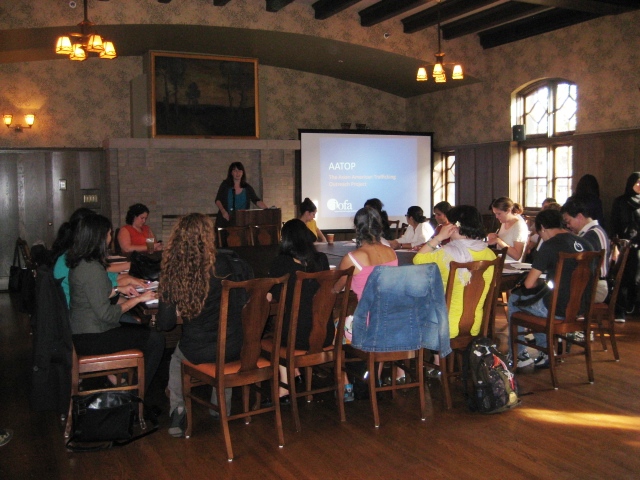
The Asian American Trafficking Outreach Project
(AATOP), a program launched by the International Organization of Adolescents
(IOFA) held its first community forum on October 24, 2012 at the Hull House
Museum. This forum was the first meeting to connect organizations from the
Asian Pacific Islander (API) community of Chicago that have interest and
expertise in the issue of human trafficking. Over forty attendees ranging fromcollege studentsto professionals
in the fields of advocacy, health, legal, education, and social services came
together to hear about AATOP and contribute to the discussion about outreach to
victims of human trafficking in underserved API communities.
IOFA provided a general introduction to the
initiative, explained the scope of human trafficking in the United States and
Chicagoland area and provided guidance on how to identify trafficking victims. Shelby
French (IOFA Executive Director) and Sehla Ashai (IOFA Anti-Trafficking Program
Specialist) segued into a description of AATOP’s goals and target activities.
Esther Liew (IOFA AATOP Program Development Intern) presented research from IOFA
that demonstrated little evidence that API trafficking victims are being
identified or provided support by a sample of API-serving organizations in
Chicago. Using this as a launching point, Shelby invited the attending organizations
and individuals to partner in AATOP efforts at various levels of participation.
Both IOFA and participating organizations will bring together expertise from
different fields with the goal of effectively reaching API trafficking victims
and agencies that serve this demographic.
We proceeded to a discussion session that addressed these questions:
Do you
believe that human trafficking is a critical issue facing API communities?
Do you
think human trafficking is being addressed adequately in API communities?
What are
the challenges to building public awareness and concern about human
trafficking?
What are
the opportunities?
Which
API communities are at greatest risk?
Who
needs to be involved to ensure success and sustainability of AATOP
efforts?
What are
the specific challenges and opportunities in relation to outreach into
this particular community?
What are
some culturally appropriate models or methods of outreach to victims of
similar crimes?
The discussion explored attendees’ understanding of the challenges
to serving trafficked victims and generated suggestions of how they themselves
can contribute to AATOP efforts.
Feedback
points included:
Human
trafficking is a critical issue facing API communities
Psychological
coercion of human trafficking can be damaging.
Service
providers in attendance have spoken and worked with trafficked individuals
but have not realized it.
Trafficking
is a big problem in the Vietnamese community. The Vietnamese American
Community of Illinois has received calls eliciting support for trafficked
victims. It has also conducted anti-trafficking programs for the
Vietnamese community.
Fear
of removing self from trafficked situation
Some
victims come to the U.S. not knowing anybody.
They get minimal provisions in the
trafficked situation, but if they leave, they are stepping out into the
unknown where there may receive no protection at all. It is scary to be in
a trafficked situation, but scarier not to know what is out there, so not
many trafficked individuals leave.
A
shelter living situation is not incentive enough for victims to leave.
Building
a connection between organizations that potentially serve API trafficking
victims
If staff
do not know how to identify a trafficking situation, they will not know
what to do when confronted with it.
Benefit
of having a coordinated network: direct service providers builds
relationships with victims and with other collaborating organizations. Victims
will choose service providers that they trust to advocate for them. They
will be less fearful of presenting their trafficking situations to a
police or lawyer if they have a professional who supports them.
Organizations
serving trafficking victims should know how to connect and coordinate with
organizations in victims’ home countries in case repatriation is necessary.
Labor
trafficking
·The difference between trafficking and labor exploitation is
blurry. What constitutes as exploitation in one culture is not the same in
another; what is “normal” in one culture is not in another.
Some
people do not understand the difference between labor exploitation and
trafficking, so we need to be clear when explaining the distinction
between the two.
Outreach
work into labor violations and employment issues face resistance because
victims and social service organizations do not want to go against
businesses. Victims may deny that there is a problem.
Some of the
largest labor trafficking cases have involved Asian workers. Labor
trafficking preys on the language gap of victims. There is success when
workers are organized to advocate for recognition of labor trafficking. However,
it is difficult to organize domestic workers because they are isolated
from each other.
There is
currently no law association with whistle blowing or “qui tam” (a writ
whereby a private individual who assists in a prosecution is entitled to a
percentage of the recovery of the penalty as a reward for exposing
wrongdoings) to empower workers to advocate. There is little incentive for
victims to challenge labor trafficking employers because of the burden of
litigation and re-traumatization. Using litigation for outreach has not
been successful, but has been successful when used for compensation.
If there
is an affluent defendant, the case will go to trial because reputation is
at stake.
AATOP’s
priority
AATOP’s
priorities are threefold: identify victims, gather services so they are
accessible to victims, and train organizations. Victims face a dilemma if
there is nowhere they can receive services. Connections are currently non-existent,
so we must put a network together.
Recommendations
for moving forward
Victims
or people who have identified a human trafficking victim can call the 24/7
National Human Trafficking Hotline (1-888-3737-888) for assistance.
Members
of the AATOP network can also call IOFA at 773-404-8831 if a victim is
identified and wants to be connected with law enforcement and/or legal and
social services in the area.
It will
take awhile to get the API community used to the concept of trafficking
outreach, so relationship-building with participating organizations and
specific communities is very important.
Have
conversations with the API community to familiarize them with human
trafficking.
Organize
community leaders to provide a safe space for victims to meet and talk
Survivor
participation: we want to hear from survivors, ask them questions, and
receive direct feedback to inform our programs.
For
those working with older refugee/non-US citizen girls under pressure to
get jobs/are working, have conversations with them about work: work hours,
language barriers, fear of being fired, what has raised questions for you,
etc.
AATOP is
in the process of translating trafficking outreach tools into culturally
appropriate terms so agencies can use them.
AATOP
can use resources from Look Beneath the Surface, a culturally appropriate trafficking
campaign.
Divide
up by target ethnic communities and by expertise to contribute to AATOP
efforts: legal, social service, capacity building, etc. For example, the
Chicago Bar Association can help with the legislative portion.
Strength
in numbers: the more organizations
we get to come on board, the more the issue will be moved to the
forefront.
Positive
peer pressure: launching point for a shift in thinking and beliefs of
other organizations.
Train
law enforcement to identify API trafficking.
College
students can be advocates on campus with their student organizations.
Next
steps for AATOP
Send out
a survey inquiring the interest and participation level of potential
member organizations
Maintain
open communication with member organizations through the AATOP blog,
listserv, and quarterly newsletters
Compile
a list of member organizations
Have
phone calls or meet with member organizations to check in on AATOP
progress on their part, then provide help where necessary
Recruit
for the AATOP steering committee
Recruit
more AATOP member organizations by reaching out to more API-serving
organizations in Chicago and inviting them to participate in AATOP
Recruit
non-organizationally affiliated community members to be supporters of
AATOP
Hold
ethnic-specific meetings with community members and interested
organizations
Awareness
building and public education
Victim
outreach
Training
and capacity building of existing organizations and resources
Ongoing
technical assistance to organizations
Enhance
legal and social services for victims
Establish
and coordinate cultural competent referral networks
The
first community forum hosted by the Asian American Trafficking Outreach Project
(AATOP) last week saw over 40 attendees! Those who were present ranged from
college students to professionals in the advocacy, health, legal, and social
service fields. This was the first opportunity for us at IOFA to introduce
AATOP to potential partners in a group setting and invite them to join us in driving AATOP efforts. We are excited to already have some organizations on board with us!
Shelby French, IOFA's director introducing AATOP at the forum
We asked the group these
following questions to generate ideas for next steps as we move forward in
producing outreach and training materials in collaboration with our partners:
Do you believe that human trafficking is
a critical issue facing API (Asian and Pacific Islander) communities?
Do you think human trafficking is being
addressed adequately in API communities?
What are the challenges to building
public awareness and concern about human trafficking?
What are the opportunities?
Which API communities are at greatest
risk?
Who needs to be involved to ensure
success and sustainability of AATOP efforts?
What are the specific challenges and
opportunities in relation to outreach into this particular community?
What are some culturally appropriate
models or methods of outreach to victims of similar crimes?
These questions generated useful discussion that we are compiling into an outcome document. We look forward to sharing the results with you!
Asian
American Trafficking Outreach Project (AATOP), a program of the International
Organization of Adolescents (IOFA) is excited to hold its first community forum
on next Thursday, October 24 at the Hull House Museum! This forum will be the
first meeting place to connect organizations with an invested interest in human
trafficking in the Asian Pacific Islander (API) community of Chicago. As a
member-driven coalition, the forum will help begin the dialogue of addressing
API needs as human trafficking victims and garner community support for
anti-trafficking sentiment and programming. It is a platform for individual
organizations to provide areas of expertise as we strategize training models,
brainstorm culturally-sensitive outreach efforts, and identify areas of
research. We have gathered the support of direct social services, research
organizations, legal representatives, educational institutions, and community
organizations who will be represented at the forum. In forming a community
network supportive of API rights, the group will present as a unified front to
the existing anti-trafficking networks in the greater Chicago area.
Check
back soon for an update on the results of our discussions and potential next
steps as we move forward!